At 94, with 75 years of revolutionary activity, 41 years as a Party Central Committee member, 35 years on the Politburo, 32 years as Prime Minister and 10 years as an adviser to the Party Central Committee, Pham Van Dong was a highly respected leader of the Party, State and people; a great national cultural figure who remained loyal and fought throughout his life for national independence and the people’s happiness.
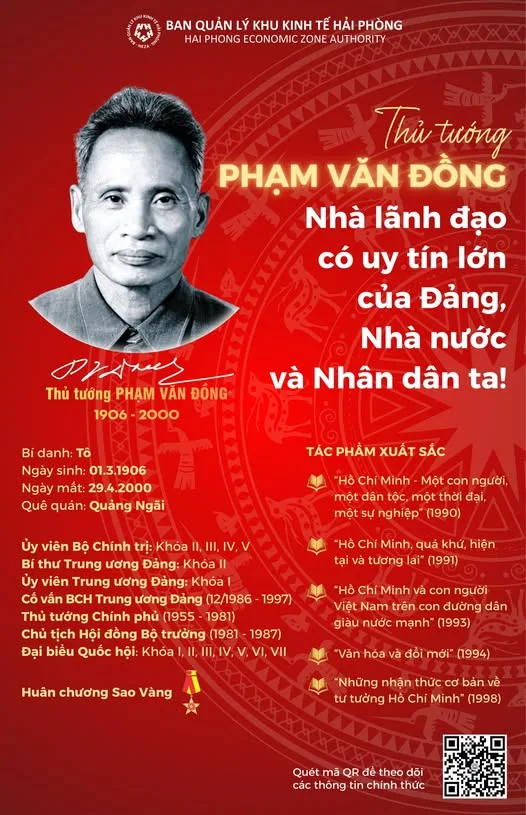
Pham Van Dong, whose alias was To, was born on March 1, 1906, into an intellectual family in Duc Tan Commune, Mo Duc District, Quang Ngai Province (now Mo Duc Commune).
 In 1921, he graduated from Dong Ba Primary School, entered Quoc Hoc Hue and encountered progressive publications, soon joining the students’ patriotic movement.
In mid-1924, he left Quoc Hoc Hue for Hanoi and entered Buoi School. In 1925–1926, he joined school strikes demanding the release of Phan Boi Chau and mourned Phan Chu Trinh.
In 1926, after embracing the revolution, he attended a cadre course in Guangzhou organized and taught by Nguyen Ai Quoc and joined the Vietnam Revolutionary Youth League.
In April 1927, he returned home and continued revolutionary work in Cochinchina. In March 1929, he was elected Secretary of the League’s Southern Regional Committee.
In May 1929, he attended the first congress of the Vietnam Revolutionary Youth League in Hong Kong and was elected to its General Executive Committee.
In July 1929, he was arrested by French secret police in Saigon, sentenced to 10 years in prison and exiled to Con Dao.
In mid-1936, he was released amid popular struggles and the French Popular Front movement and returned to Hanoi. Though under house arrest, he re-established contact with the Party and continued revolutionary work.
In May 1940, he was sent to Kunming, China, to work with Nguyen Ai Quoc in preparing his return to lead Vietnam’s revolution. He formally joined the Indochinese Communist Party and worked in Liuzhou and Jingxi.
Returning to Cao Bang in early 1942, he helped organize the Viet Minh, managed the Vietnam Independence newspaper, built bases and prepared forces for the general uprising.
At the August 1945 National Congress in Tan Trao, he became a Standing Committee member of the Vietnam National Liberation Committee. After the August Revolution, he was Minister of Finance in the Provisional Government and Deputy Head of the first National Assembly’s Standing Committee.
In late May 1946, he led the Democratic Republic of Vietnam Government delegation in official negotiations with the French Government at the Fontainebleau Conference.
In January 1947, he became an alternate Party Central Committee member and a special envoy directing resistance and nation-building in the South Central region.
In 1949, he returned to Viet Bac, became an official Party Central Committee member, and served as Deputy Prime Minister and Deputy Chairman of the Supreme National Defense Council.
From the Party’s second through sixth congresses (1951–1986), he served on the Party Central Committee and Politburo. From 1955–1987, he was Prime Minister and Chairman of the Council of Ministers, also serving as Foreign Minister, Head of the Party’s Foreign Relations Commission and head of the Vietnamese delegation to the 1954 Geneva Conference on Indochina.
From 1986–1997, he was an adviser to the Party Central Committee and a National Assembly deputy in the first through seventh terms.
 Pham Van Dong died on April 29, 2000, at the age of 94.
 With 75 continuous years of revolutionary activity, 41 years on the Party Central Committee, 35 years on the Politburo, 32 years as Prime Minister and 10 years as an adviser, Pham Van Dong made immense contributions to the Party and nation and received the Gold Star Order and many other honors.
Source:
Hai Phong Center for Investment Promotion, Employment and Business Support