
Deep-water seaports, an airport opening the way to the world, expressways and transport corridors that shorten regional distances, together with industrial parks and economic zones, create the foundation for large-scale production.

Seaports and airports open the way to the world
Hai Phong is not the only locality with maritime advantages, nor is it the only place developing industry. However, over the past 1 decade, Hai Phong has emerged as one of the country’s most dynamic growth poles by turning geographical advantages into infrastructure advantages, and then transforming infrastructure into production capacity, exports and investment attraction.
In 2025, following its merger with Hai Duong, the city’s GRDP grew by 11.81%, ranking first among centrally governed cities and marking the 11th consecutive year of double-digit growth. GRDP has expanded strongly each year. In 2025, it reached VND 734,420 billion, equivalent to approximately USD 29.3 billion, nearly 2.7 times the 2020 figure and nearly 5.6 times the 2015 figure.
Total state budget revenue in the city reached VND 197,810 billion in 2025, 2.35 times the 2020 figure and approximately 3.4 times the 2015 figure. These figures show that Hai Phong is not merely growing rapidly in the short term; it has built a growth foundation with long-term pulling power.
The city has established a clear development structure: seaports and logistics serve as gateways; interregional transport forms connecting corridors; industrial parks and economic zones provide production space; and administrative reform acts as soft infrastructure for attracting businesses. Within this structure, infrastructure is no longer a supporting element that follows growth; it has become a condition that opens the way for growth.
For Hai Phong, the seaport is an advantage, but it becomes a true growth driver only when the city has deep-water ports capable of receiving large vessels and connecting directly to international shipping routes. Previously, some of northern Vietnam’s import and export cargo had to be transshipped through regional ports, increasing logistics costs, extending transport times and reducing the competitiveness of goods moving to and from Hai Phong.

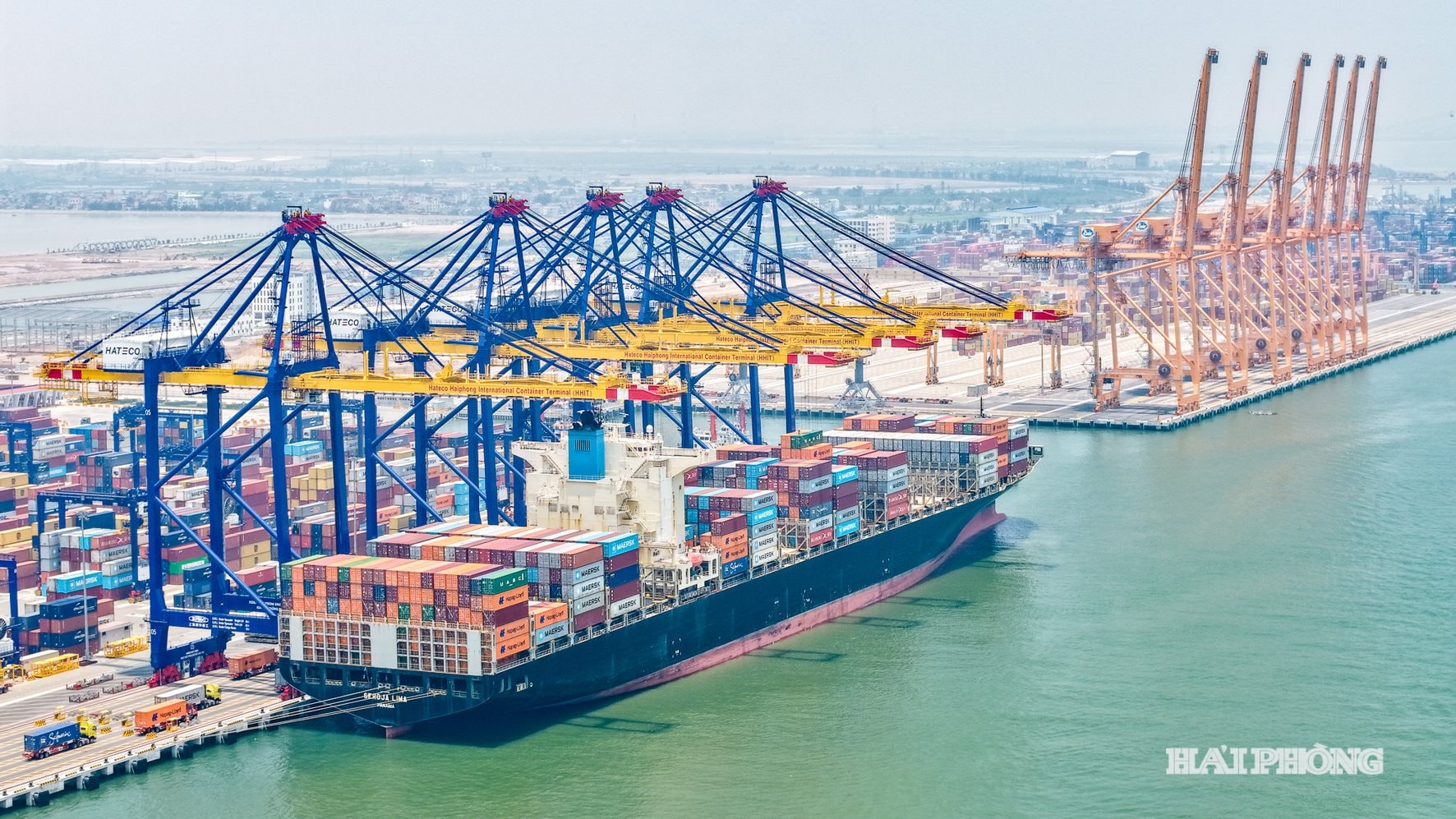
The formation and expansion of Hai Phong International Gateway Port has elevated the seaport position of the port city. The construction of the Tan Vu–Lach Huyen bridge and road system, the commissioning of the first 2 deep-water berths in 2018, the opening of direct international mainline services in 2019, and the subsequent addition of berths 3, 4, 5, 6, 7 and 8 have fundamentally transformed Hai Phong’s seaport capacity.
This port area can receive large vessels from 100,000 to 165,000 DWT, and even vessels of up to 200,000 DWT under reduced-load conditions. It is capable of operating direct mainline services to Europe and the Americas without transshipment through a third country.
The Lach Huyen port system not only enables the city to receive large vessels, reduce logistics costs and expand imports and exports; it also provides a foundation for attracting FDI, developing processing and manufacturing industries and logistics, and expanding the economic space seaward.
As northern Vietnam’s gateway to the sea, Hai Phong Port serves as the outlet for goods from Hanoi, Hung Yen, Bac Ninh, Thai Nguyen, Quang Ninh and many localities in the Red River Delta. The city’s role as a logistics centre is increasingly demonstrated by the strong growth in cargo throughput through its seaports.
During 2016–2020, port cargo throughput reached approximately 400 million tonnes, growing by an average of 15.9% per year. During 2021–2025, this figure rose to 891.3 million tonnes, more than 2.2 times the previous period. In the first 4 months of 2026, port cargo throughput reached nearly 59 million tonnes, up 11.6% year on year. The city completed and synchronously put berths 1 through 8 into operation, continuing to improve cargo handling capacity and connections with the northern regional supply chain.
In July 2025, the Government approved the investment policy for a project to build berths 9, 10, 11 and 12 in the Lach Huyen port area. The project will help form a modern seaport system capable of receiving large container vessels of 12,000–18,000 TEU. It will be implemented in phases: berths 9 and 10 during 2026–2030, followed by berths 11 and 12 during 2031–2035.
The role of Cat Bi International Airport in Hai Phong’s growth also deserves attention. Cat Bi’s first contribution is to shorten economic distances. For an industrial and logistics centre attracting strong FDI flows like Hai Phong, investors, experts, engineers, customers and partners need to travel quickly.
Second, it promotes tourism and services, adding a growth driver beyond industry. Hai Phong has Cat Ba, Do Son, a coastal urban centre, resort tourism and connectivity with Quang Ninh, Bac Ninh and Hanoi.
Third, it adds air logistics capacity to the seaport system: Cat Bi receives millions of passengers and tens of thousands of tonnes of cargo each year. In recognition of its growing role, Hai Phong broke ground in 2025 on Terminal T2 to increase operating capacity and meet passenger and cargo growth in the new period.
Roads are the “lifeblood” of interregional circulation
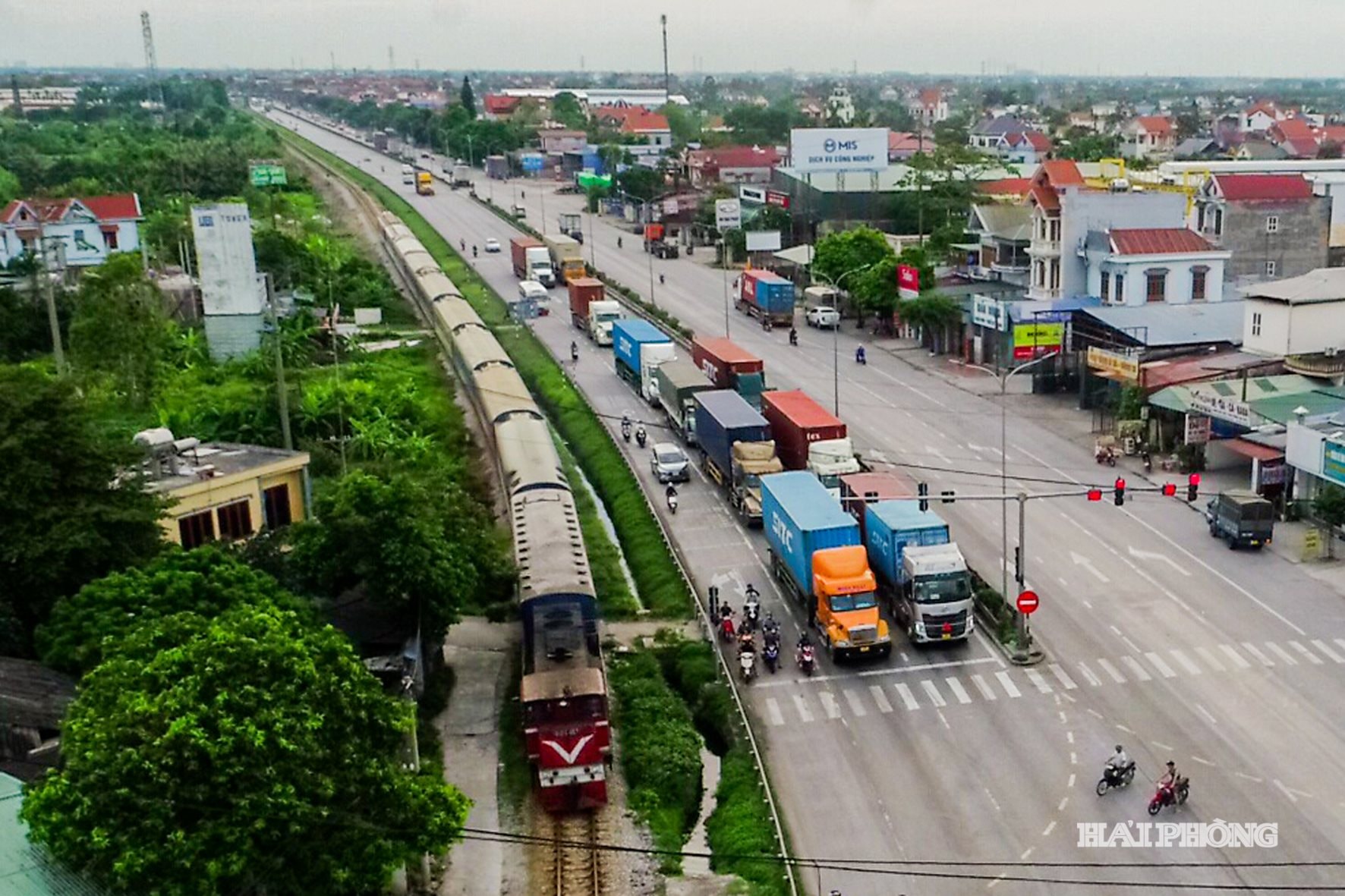
The road transport system, including the Hanoi–Hai Phong and Hai Phong–Ha Long–Mong Cai expressways, National Roads 5 and 10, and the Hanoi–Hai Phong railway, acts as the “lifeblood” connecting Hai Phong with major economic centres across the country and has provided an important foundation for the city’s strong breakthrough in recent years.
The development of expressways, arterial national roads, ring roads, river-crossing bridges and coastal roads has significantly shortened travel times, reduced logistics costs and improved interregional connectivity. The Tan Vu–Lach Huyen bridge and road system directly connects the mainland with the Lach Huyen deep-water port area, substantially reducing the time required to transport goods to the port.
With synchronized infrastructure, Hai Phong is no longer developing mainly on the basis of traditional seaport advantages. It is gradually becoming an important trading hub for the northern coastal region and an import-export gateway for northern Vietnam.
Goods from localities such as Hanoi, Hung Yen, Bac Ninh and Quang Ninh, as well as the northern midland and mountainous provinces, can connect quickly to Hai Phong’s seaport and logistics systems, improving cargo transshipment capacity. Many investors choose Hai Phong not only for its seaport advantages but also for the convenient connections among road, sea, rail and air transport.
Expressways are changing industrial planning thinking. Instead of every factory having to be located near a port, industrial parks can be distributed more widely along transport corridors. Factories in Hung Yen, Bac Ninh, Quang Ninh and Thai Nguyen can still use Hai Phong Port as an import-export gateway. Hai Phong also benefits as cargo flows in from localities across the region, increasing logistics throughput and the demand for warehousing, transport, insurance, finance and supporting services.
Once the city’s east–west high-speed road, the Ninh Binh–Hai Phong expressway and the Lao Cai–Hanoi–Hai Phong railway are completed, they will further expand the city’s development space to the south, west and neighbouring areas. Given the large volume of cargo passing through Hai Phong’s ports each year, the expressway, national road and interregional logistics corridor systems are increasingly demonstrating their particularly important role in the city’s economic growth.
Le Anh Quan, Member of the Standing Committee of the Municipal Party Committee and Standing Vice Chairman of the People’s Committee, said that Hai Phong’s growth mechanism, particularly the role of infrastructure, can be understood through 3 factors.
First is cost reduction. Deep-water ports reduce transshipment costs, expressways reduce domestic transport costs, and synchronized industrial parks reduce businesses’ initial investment costs. When costs fall, businesses gain more room to compete on price, expand production and increase exports.
Second is time savings. In a modern economy, delivery speed, processing speed and the speed of connecting factories, ports and markets determine competitiveness. Good infrastructure gives businesses greater control over orders, especially in sectors with global supply chains and strict delivery requirements.
Third is scale expansion. When ports can receive larger vessels, industrial parks have more space and expressways open additional connections, the city can accommodate larger projects. This creates a multiplier effect: port throughput, exports, FDI, budget revenue, employment and urban services all grow.
Source: Compiled