Hai Phong continues to create a favorable investment and business environment so that the private sector can keep developing and become an important driver of the economy.

The private sector is an important driver of Hai Phong’s economic development
An important driver
Hai Phong currently has more than 30,000 operating enterprises, with over 90% being small and medium-sized businesses in logistics, mechanical engineering, electricity, electronics, seaports and other service sectors. These enterprises made significant contributions to the development of the private sector during 2020–2024. The share contributed by private enterprises to Hai Phong’s economy reached 40–48% over the past 5 years.
Given their contribution to the city’s GRDP growth, the private sector can be affirmed as an important driver of economic development.
This is demonstrated by Hai Phong’s economy maintaining high double-digit growth during 2019–2023, averaging 12.6% per year, 2.44 times the national average. The locality maintained two-digit growth for 10 consecutive years, while the city’s per-capita GDP improved significantly, reaching 11.64% per year during 2019–2023, 2.83 times the national average per-capita GDP growth.
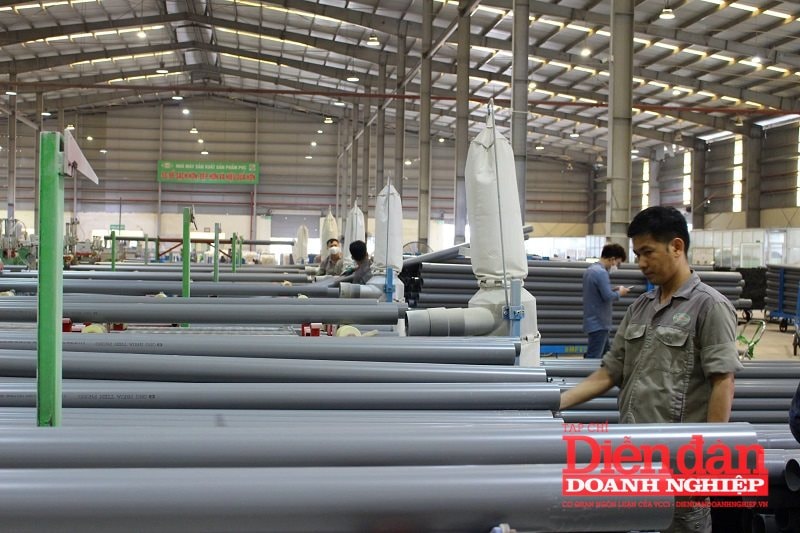
The share contributed by private enterprises to Hai Phong’s economy reached 40–48% over the past 5 years
Despite its major contribution to economic development, the private sector faces many challenges. Most local enterprises are small and medium-sized, with limited internal capacity in capital, technology and high-quality human resources. The macro-policy system still has shortcomings, creating a wide gap between private enterprises, state-owned enterprises and the FDI sector.
State-owned and FDI enterprises are often prioritized in land, credit and support policies, while private enterprises face overlapping inspections, informal costs, complicated administrative procedures and limited opportunities to participate in public procurement and major value chains. Many existing incentives remain focused on the state sector or large-scale projects, while small and medium-sized enterprises are almost overlooked.
According to Nguyen Thanh Phuong, General Director of Sao Do Group, removing barriers and opening the way for the private sector in Hai Phong requires not only enterprise initiative but also early support policies from agencies and sectors. Sound institutions, mechanisms and policies that create an open environment would allow businesses to access resources, low-cost loans and tax incentives, creating leverage for private enterprises to develop and contribute more to overall development.
Le Tat Quoc Anh, Deputy Director of Sao Do Logistics Joint Stock Company, shared: “Our enterprise strongly expects state management agencies to soon develop and issue specific mechanisms and policies suited to reality, creating favorable conditions for the private sector to develop strongly and sustainably. In particular, there should be synchronized and strategic investment in logistics infrastructure, faster digital transformation, encouragement of innovation and application of advanced technology in production and business. Promoting links between domestic enterprises and international partners is also important for improving competitiveness. Practical policies to support, train and develop high-quality human resources are essential for enterprises to integrate deeply and adapt to the global economic context.”
Creating a new driving force
In 2025, Hai Phong set a growth target of 12.5%. To achieve it, one of the locality’s tasks and solutions is to promote private-sector development.
Alongside implementing central policies, Hai Phong has introduced many solutions to support the private sector. The city has continuously improved the investment and business environment, built exemplary models and accelerated digital transformation in processing enterprise administrative procedures. It also regularly organizes business dialogues from the grassroots to city level to identify difficulties in the private sector and promptly resolve them, while creating favorable conditions for private enterprises to renew technology, raise productivity and improve product quality.
Most recently, to lead the city’s private sector and strengthen the “resilience” of the business ecosystem, the Hai Phong Business Association was officially established. It will gather and represent the business community, act as a bridge between enterprises and the city administration, promptly reflect business difficulties, advise and propose policies supporting local economic development and improve the investment and business environment. It will connect and establish mechanisms and favorable conditions so that enterprises, especially small and medium-sized businesses, can gradually join the production, distribution and service value chains of major domestic and foreign corporations. It will also support the business community in improving competitiveness and promote the role of the private sector in Hai Phong.
Assessing the role of the private sector, Hai Phong Party Secretary Le Tien Chau said its development is clear evidence of the effectiveness of the tasks and solutions implemented by Hai Phong to promote all economic sectors, including the private sector. Hai Phong will continue creating a favorable investment and business environment so that the private sector can develop strongly and become an important driver of the economy.
Source: Business Forum Magazine