
Hai Phong has been developing plans and introducing dedicated mechanisms and incentives for workers when they purchase or rent social housing (SH). Statistics show that about 20–25% of workers in the city need to purchase or rent SH.
According to the Hai Phong Labor Confederation, it currently manages more than 2,800 grassroots trade unions, representing 615,300 workers, public employees, and officials, including nearly 592,800 trade union members. More than 297,000 workers are employed in industrial parks and economic zones alone. This young, dynamic workforce, whose qualifications are continuously improving, makes a major direct contribution to Hai Phong’s development. However, as industrial parks expand rapidly, social welfare needs—especially workers’ need for stable housing—are becoming increasingly urgent.

The 384 Le Thanh Tong Social Housing Project in Ngo Quyen Ward is partially handing over apartments to customers.
According to Mr. Nguyen Van Phiet, Vice Chairman of the Hai Phong Labor Confederation, many workers in Hai Phong currently live in informal rental housing with limited conditions, cramped spaces, inadequate essential amenities, and sometimes insufficient security and fire prevention measures. These rental areas lack essential amenities, affecting family life and children’s education. The distance from housing to the workplace is also considerable, increasing travel costs and time. Although the city has paid attention to planning and implementing several SH projects, supply remains modest and does not yet meet workers’ very substantial current demand.
A survey by trade unions and relevant organizations shows that about 20–25% of workers currently working in Hai Phong genuinely want to purchase or rent SH. They want to stay with the city long term, stabilize their housing and lives, settle down so they can work with peace of mind, and contribute to their businesses and the sustainable development of Hai Phong.
Regarding current demand for purchasing or renting SH, Mr. Pham Tien Hoa of Cheng V Co., Ltd. in Do Son Industrial Park said the company employs hundreds of workers from other provinces, creating very high demand for SH. However, SH prices in Hai Phong remain fairly high, making access difficult for workers. In addition, SH projects are unevenly distributed: some areas have many projects while others have few. There is currently no SH area near Do Son Industrial Park.
Mr. Hoa also expressed his hope that Hai Phong would prioritize rental social housing projects and develop projects near industrial parks with large worker populations, making access easier and meeting the housing needs of workers from other provinces.
In reality, workers’ housing demand in Hai Phong is no longer latent; it has become an urgent need. To clarify SH policies for workers in the city, the Hai Phong Labor Confederation recently coordinated with relevant agencies to organize a workshop explaining SH policies for workers in Hai Phong.

Workshop on social housing policies organized by the Hai Phong Labor Confederation on the afternoon of December 6
At the workshop, SH project investors and competent Hai Phong authorities exchanged information with workers about SH and workers’ housing projects currently being sold or implemented in Hai Phong; eligibility to purchase SH; required applications and documents; and procedures for registering to purchase or rent SH. Workers at businesses and industrial parks also raised questions and recommendations, including that SH prices remain high, direct access to investors is difficult because applicants must go through agents, and accessing preferential loans from banks remains challenging.

Workers in Hai Phong raise questions and recommendations about procedures and prices for purchasing or renting social housing.
Responding to workers’ opinions on social housing, Mr. Nguyen Hoai Long, Deputy Director of the Hai Phong Department of Construction, said Hai Phong aims for average annual growth of 13%–14% during 2026–2030. A core solution is to develop social housing to attract workers to Hai Phong, meet housing demand among low-income people, stabilize their lives, and support settled livelihoods.
Mr. Long also said that Hai Phong currently has nine SH projects on sale, with approved prices ranging from VND12 million to VND22 million per m2. Buyers mainly include workers employed by businesses; civil servants and public employees; the armed forces; and low-income urban residents.
Specifically, since the beginning of 2025, several other SH projects in the city have completed portions and handed over apartments to customers, including the No. 39 Luong Khanh Thien Street SH Area Project in Gia Vien Ward; the 384 Le Thanh Tong SH Area Project in Ngo Quyen Ward; the five-story apartment project at Alley 75 Ly Thanh Tong in Do Son Ward; and the Happy Home Trang Cat SH Area Project in Hai An Ward.
Previously, in late 2024 and early 2025, the SH project under the Trang Due New Urban Area – Commercial Services and Workers’ Housing Project in An Duong Ward, with 2,500 apartments, was completed. Apartments in the first building, CT1, were handed over to customers six months ahead of schedule.
Many other SH projects are being built at an extremely urgent pace—“working through sun and rain and standing firm against storms”—including a large SH project on 16.9 ha with 10 15-story apartment blocks and 4,456 apartments. The Tong Kho 3 Lac Vien SH Area Project in Ngo Quyen Ward is concentrating construction efforts to ensure that the first apartments are handed over to customers in the first quarter of 2026.
In western Hai Phong, construction of the SH Area Project in the expanded Tan Phu Hung residential and urban area is progressing rapidly. The project is accelerating toward the goal of topping out all five 15-story apartment buildings in December 2025.
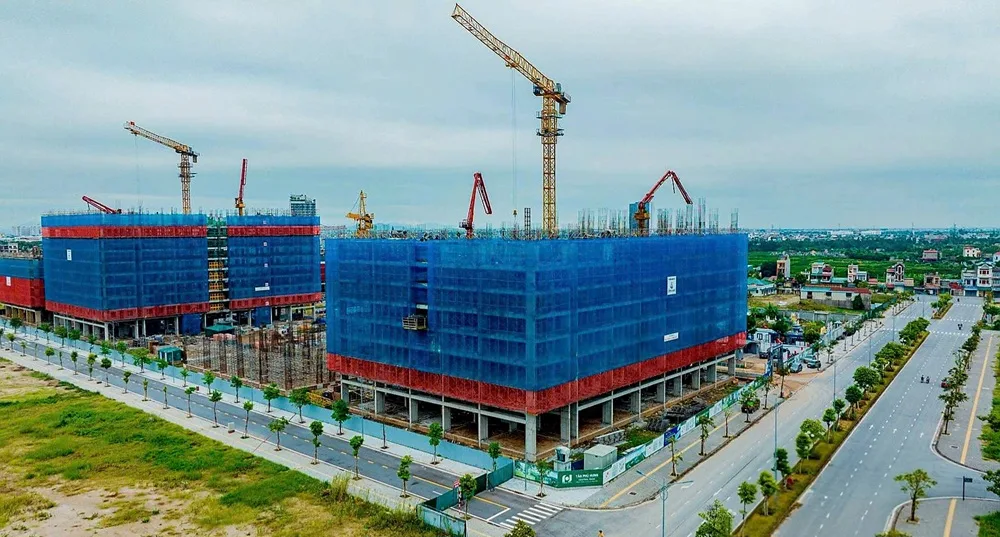
The SH Area Project in the expanded Tan Phu Hung residential and urban area is under urgent construction.
This is one of the major SH projects underway in western Hai Phong, with 1,479 apartments on nearly 3.2 ha of land and expected completion in the second quarter of 2027. The project was approved by the Hai Phong Department of Construction, which publicly announced a provisional price of approximately VND17.6 million per m2.
During 2021–2025, four SH projects with a total of 2,867 apartments were and are being implemented in western Hai Phong. To date, 662 apartments have been completed, and a further 2,205 are expected to be completed by the end of 2025.
The city currently has 23 SH projects underway, totaling 26,715 apartments. In 2025, 10,775 SH apartments are expected to be completed across the city. Of these, 8,570 will be completed in the east and 2,205 in the west, exceeding the target assigned by the Prime Minister and meeting residents’ demand for SH.
The city is also adjusting its SH development goals and targets for 2021–2030 to align with the new administrative boundaries following the merger. The updated total target for Hai Phong’s SH development through 2030 is 49,455 apartments, based on the combined targets of the former Hai Phong City and former Hai Duong Province. At the same time, Hai Phong has been developing plans and dedicated mechanisms and incentives for workers when they purchase or rent SH.
The Hai Phong City People’s Committee issued Decision No. 133 of 2025 detailing cases in which people who own housing but live far from their workplace may be considered for SH support policies in the city. The Department of Construction will consolidate all workers’ opinions and recommendations to advise the city and develop Hai Phong as a model for SH development based on three outstanding characteristics: “Location – Quality – Price.” This includes housing segments suited to the needs of most residents and workers.
Mr. Nguyen Anh Tuan, Vice Chairman of the Vietnam Fatherland Front Committee of the city and Chairman of the Hai Phong Labor Confederation, affirmed that the city Labor Confederation always provides practical attention and concrete care to improve workers’ benefits, especially by giving workers from other provinces better conditions and opportunities to build long-term ties with the port city.
Source: Dau Tu Newspaper